






Saint Padre Pio: “Pray, Hope, and Don't Worry”
Every September 23, the Church celebrates Saint Pio of Pietrelcina, known to millions simply as Padre Pio. He almost never traveled. He spent fifty years in one small friary in the mountains of southern Italy. And yet people crossed oceans to kneel in his confessional, and pilgrims still come to San Giovanni Rotondo from all over the world.
Here is who he was, why the Church calls him a great saint, and how you can keep his feast this week.

A friar from a farming town
He was born Francesco Forgione on May 25, 1887, in Pietrelcina, a small farming town in southern Italy. His family worked the land. On January 22, 1903, at fifteen, he received the habit of the Capuchin friars and took the name Pio. He was ordained a priest on August 10, 1910.
In September 1916 he was sent to the friary of Our Lady of Grace in San Giovanni Rotondo. He would stay there for the rest of his life.

The wounds he carried for fifty years
On September 20, 1918, while praying after Mass, he received the stigmata: wounds in his hands, feet and side like those of Christ. He carried them for fifty years, until the end of his life. He never sought attention for them and covered the wounds on his hands with half-gloves. He described himself simply as "a poor friar who prays."
The altar and the confessional
What Padre Pio gave his life to was not the wounds. It was the Mass and the confessional. People who attended his Mass remembered how slowly and intently he offered it. For decades he heard confessions from morning until evening, and countless people who came to him curious left reconciled with God.
Why he is a great saint
The Church does not canonize someone for extraordinary signs. It looks for heroic virtue: a life of faith, hope and charity lived to an uncommon degree. In Padre Pio, that virtue is easy to see.
- He prayed without stopping. His days were built around the Mass, the Liturgy of the Hours and the Rosary, which he prayed constantly. Everything else he did came out of that prayer.
- He gave himself to sinners. Confession was his daily work for half a century. He was demanding and direct, because he wanted people truly converted, not merely comforted.
- He obeyed when it cost him. In 1931 the Holy See ordered him to stop all public ministry and to celebrate Mass only in private. He accepted it without rebellion. Two years later the restrictions began to be lifted, and his faculties were gradually restored.
- He offered his suffering. Beyond the stigmata, he lived with illness and misunderstanding for most of his life. He united that pain to the Cross and asked people to do the same with theirs.
- He turned faith into charity. He championed a hospital for the poor and the sick, the Casa Sollievo della Sofferenza, the Home for the Relief of Suffering, which opened on May 5, 1956, and still serves patients today.
- He stayed humble. Millions knew his name, and he still called himself a poor friar who prays.
- The Church confirmed it. He died on September 23, 1968. After a careful investigation of his life and of miracles attributed to his intercession, Pope Saint John Paul II beatified him on May 2, 1999, and canonized him on June 16, 2002.
"Pray, hope, and don't worry"
Of all the counsel attributed to him, the simplest is the one people remember: pray, hope, and don't worry. It is not a slogan for easy days. It is advice from a man who knew suffering, offered to people carrying heavy things.
The coffee that carries his name

Our Padre Pio Dark Roast is a little like the friar himself: bold on the surface, gentle at the finish. It is our signature washed Central American coffee (SCA 84) taken to a true dark roast (Agtron 35), with dark chocolate, a full body and a lingering sweet aftertaste. It comes in 12 oz and 5 lb bags, whole bean or ground.
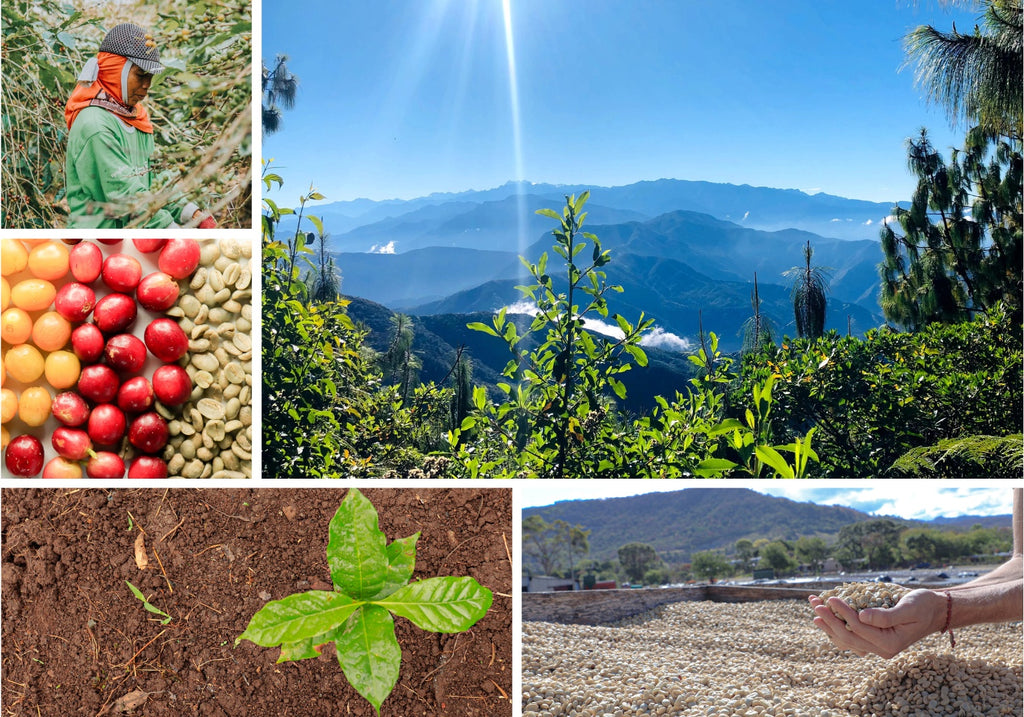
Like every Guadalupe coffee, it is Traceably Catholic: grown by Catholic farming families in Latin America and roasted on demand at origin. And for every pound sold, we donate a Rosary.
Three small ways to keep his feast
- Pray one decade of the Rosary for someone who is suffering.
- Make time for confession this week.
- Brew a cup, sit for five quiet minutes, and hand your worries over.
Saint Padre Pio, pray for us.
Historical photographs of Padre Pio: public domain, via Wikimedia Commons.